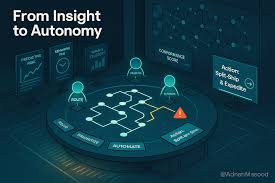
Companies want their AI systems to be more efficient, quicker, and more accurate in the rapidly changing business environment of today. AI technology is now used in almost every part of a company, such as customer service, finance, supply chains, and operations. SLMs (small language models) and LLMs (large language models) are two AI-related technologies that have been in focus recently. Nevertheless, one of the obstacles is to instruct these AI models to understand enterprise processes. Mining procedures is the solution here.
Process mining is the method that allows organizations to know the way their internal processes function. It derives the middle of the IT system data, logs, and traces to reveal the real task flow in a company. Simply put, it provides your corporation with a magnifying glass. You can see the places where the work is getting stuck, unnecessarily repeated, or delayed. Such information is absolutely vital to the setting of AI systems, especially of SLMs and LLMs.
Understanding SLM vs LLM
We can learn about SLM vs LLM before moving on.
- SLMs (Small Language Models) are AI models made to perform specific functions. They do not weigh much, are quick, and can be educated using a limited number of data. SLMs are great for activities that are goal-oriented, such as responding to questions from customers, guiding employees through certain workflows, or automating small repetitive tasks.
- LLMs (Large Language Models), in contrast, are AI models of gargantuan proportions that have been trained on large amounts of data. They are capable of understanding complicated stuff written in natural language, producing new text, summarizing content, and even creating new content. The range of things that LLMs can do is quite large, and they are quite powerful, but at the same time, they require a large amount of data, computing power, and a training process that has to be done with care.
Your decision between SLM and LLM should be based on the nature of the task. An SLM is a good fit when the task is both simple and specific. An LLM would be a better choice if your work entails understanding complex language and/or multiple operations. However, no matter what kind of model you decide to go with, training data quality is always the most important factor. And this is the point at which process mining comes in handy.
Why Process Mining Matters
Frequently, companies assume that they know the flow of work in their business. Managers draw up flowcharts and write down the rules for various processes. However, it turns out that employees may be doing things differently. Some people search for loopholes, bypass stages, or do double work in a way that has not been officially documented. Traditional methods such as conducting surveys or interviews may overlook these details.
Process mining is the answer to such a problem. What it does is that it obtains data from the systems and displays the process that has occurred in a very detailed manner. Corporations, through the use of this technology, are capable of:
- Identify real workflows – Be aware of the actual workflow that employees follow.
- Spot inefficiencies – Identify bottlenecks, repeated steps, or time losses.
- Detect variations – Get to know the places where employees or groups take different paths.
- Measure performance – Have information on how long the tasks are taking and where the changes for the better need to be made.
Such information is very valuable for AI training since AI models are data consumers. In other words, the quality and quantity of data determine the AI’s performance.
Training SLMs and LLMs with Process Mining Insights
In their endeavor to train SLMs or LLMs, companies usually provide AIs with process documents, manuals, or general pieces of information. The problem is that these sources seldom represent true operations. So, if AI only learns from manuals, it might come up with suggestions that are not efficient or feasible at all.
Techniques of process mining help AI models to get acquainted with the fact that the actual work processes are different from what is commonly believed. Therefore, they work as follows:
1. Creating Accurate Training Data
Without data, which is the base for AI training, whether SLMs or LLMs, AI would not be able to learn. Process mining is an instrument that delivers well-organized data that accurately depicts real scenarios of business processes. Such data covers the process for every step, decision point, delay, or exception in workflows. As a result, when AI models are trained on real workflows, the models not only learn more but also understand less theoretical ones.
For instance, the example of the finance team that processes invoices would be perfect. According to the manuals, the process starts from the moment the invoice is received and ends with the approval. However, in truth, some invoices undergo extra checks, while some are allowed to go through without certain steps being done. If AI is being trained on actual process logs, then it can be said that the AI understands these subtle differences. Hence, mistakes become fewer, and the AI utility is higher.
2. Improving Decision-Making
SLMs and LLMs are often used to support decision-making. For this, AI needs to understand the business logic behind processes. Process Mining shows patterns of decisions in real workflows. AI models trained with these insights can suggest better decisions, identify exceptions, and recommend actions that match actual business operations.
For instance, in supply chain management, an LLM trained with Process Mining data can predict delays, suggest alternative routes, or recommend which suppliers to prioritize. This makes AI a trusted assistant rather than just a tool.
3. Reducing Bias and Errors
Data used to train AI can have biases. If AI only sees ideal processes, it might fail in real scenarios where deviations occur. Process mining exposes these variations, helping AI learn all possible paths and exceptions. This is critical for enterprise AI because errors in real workflows can be costly.
SLMs, with their smaller size, benefit from focused insights to perform tasks correctly. LLMs benefit from seeing all variations, which allows them to generalize and make smart recommendations across departments.
4. Continuous Learning
Processes are not static. Businesses change rules, adopt new tools, or adjust workflows. Process mining is ongoing, capturing these changes in real time. AI models trained with continuous process mining insights can stay up-to-date. This enables enterprises to have self-learning AI systems that adapt to changing workflows without requiring constant manual retraining.
Benefits of Combining Process Mining with AI
Integrating process mining with SLMs and LLMs offers several advantages:
- Efficiency Gains: AI can automate repetitive tasks accurately because it understands real workflows.
- Better Predictions: AI can forecast outcomes and bottlenecks based on actual historical data.
- Improved Compliance: AI ensures processes follow rules by learning from real actions and exceptions.
- Cost Savings: Reducing errors, rework, and delays lowers operational costs.
- Enhanced Decision Support: AI can provide actionable insights and recommendations grounded in reality.
Real-World Use Cases
- Finance and Accounting: Process Mining tracks invoice approvals, payments, and reconciliations. AI models trained with this data can automate approvals and detect anomalies.
- Customer Service: AI can suggest the fastest resolution paths by learning from real customer interactions.
- Supply Chain: AI predicts delays, recommends alternatives, and helps plan better based on process mining insights.
- HR and Recruitment: AI can optimize hiring workflows by learning from actual hiring timelines and steps.
Steps to Get Started
If a business wants to combine process mining with SLMs or LLMs, they can follow these steps:
- Collect process data: Gather logs, timestamps, and digital footprints from systems.
- Analyze workflows: Use process mining tools to visualize real operations.
- Prepare training data: Convert insights into structured formats for AI training.
- Train AI models: Feed the data into SLMs or LLMs for learning.
- Test and validate: Ensure AI suggestions match real-life scenarios.
- Iterate continuously: Update AI as workflows change, using new process mining insights.
Conclusion
Artificial intelligence is a major factor in the competition to make enterprises more intelligent. The success of AI models (whether SLMs or LLMs) is however dependent on their comprehension of actual business processes. Process mining is the source of indispensable information for this comprehension. By uncovering real workflows, exceptions, and bottlenecks, it makes sure that AI gets practical and applicable knowledge. The synergy of process mining and AI results in intelligent automation, improved decision-making, reduced errors, and cost-effective operations. A firm deciding to use an SLM for simple tasks or an LLM for complicated functions will find that process mining is the way to ensure that the AI is trained on reality, not just theory. The path to building self-learning, adaptive, and efficient enterprise AI is therefore a must rather than a choice.