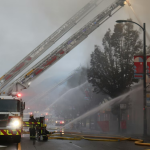
A friend of mine almost lost his ten-year-old printing business last year. Nope. It wasn’t the bad economy or a bad business decision. It was something less dramatic, a small electric fire that started in the back office just before closing time.
They were able to contain the flames before they spread to other parts of the business, but the smoke and water damage? It shut him down for months. If he didn’t have the right commercial property insurance, he would have been closed for good.
Unlike my friend, many business owners think their business is just an idea or a website. But it’s also the roof over the business. The machines that make things work. The inventory on the shelves, and so on.
And those assets are always at risk.
So, what exactly is commercial property insurance, and how did it help my friend?
Read on to find out.
What Is Commercial Property Insurance?
Commercial property insurance protects your business from loss to your business property and what is in it. It helps you pay for, repair, or replace your business assets if they’re damaged in a covered event.
Think of it as the business equivalent of homeowners’ insurance, but this time around, it’s not about safeguarding your personal laptop or your wedding ring at home. It’s about the things your business depends on.
Take fire outbreaks, for example. There were more than 119,000 non-residential fire outbreaks in the U.S. in 2024. These fires caused a whopping $3.6 billion in direct property damage. Losses like these are exactly what commercial property insurance is designed to protect against.
So who actually needs commercial property insurance?
The truth is that anyone who runs any form of business out of a physical space needs it. Even if you run your business out of your home, you also need it because your homeowners’ policy will not cover your business assets.
What Does Commercial Property Insurance Cover?
So, what exactly do you get when you invest in commercial property insurance? Let’s break it down:
- Physical Building: The physical building where you run your business is covered by this insurance. If you own the building, this usually means complete cover. If you’re leasing, your policy typically covers any improvement you make to the structure.
- Business Personal Property: This insurance policy also covers everything inside the physical building. This is known as business personal property, and can include furniture and equipment.
- Inventory: This is a big one. Business property insurance typically covers your inventory, whether it is finished goods ready for distribution, work in progress, or the raw materials you use to make your products.
- Business Income & Extra Expense: This feature is designed to replace the money your business loses and covers extra costs if you have to stop operations because of a covered loss, like a fire or major water damage.
Moody Insurance Worldwide recommends taking the time to calculate how much coverage your specific business actually needs, so you’re fully protected if repairs or rebuilding require that you close temporarily.
Most policies cover what are known as perils. These are events like fire outbreaks, smoke, theft, vandalism, burst pipes, etc, that could put your business assets at risk. If you’re worried about natural occurrences like floods or earthquakes, however, you’ll have to buy those as separate add-ons.
What Influences the Cost of Commercial Property Insurance?
If you have some experience with insurance, you know that your premiums are not just picked out of thin air. They’re based on actual risk factors. So, how do insurance companies calculate for commercial properties?
They use what is called the COPE formula. It stands for Construction, Occupancy, Protection, and Exposure.
- Construction: First, they look at what your building is made of. A building that’s CONSTRUCTED with brick is usually cheaper to insure than one built with wood. Why? Because it doesn’t burn as easily.
- Occupancy: Next, the insurance company will look at who and what is OCCUPYING the building. It goes without saying that a chemical plant with lots of chemicals in a building is a higher risk than a bookkeeping office.
- Protection: What have you done on your own to limit damage to your property? In the event of a fire outbreak, do you have a sprinkler system? Do you have a security system to deter burglars? Improving safety, security, and maintenance in your place of business can lower your commercial insurance premiums.
- Exposure: Finally, they look at how EXPOSED your business is. If your property is located next to a fireworks factory, it doesn’t matter what you do or how safe your business is; your risk goes up, and this means a higher premium.
The 2025 Los Angeles wildfires offer a good example of exposure. The NY Post reports that both the Palisades and Eaton fires resulted in an estimated loss of $8.3 billion in property value. You can bet that insurers will charge heavy premiums to businesses in high-risk areas like these.
How to Choose the Right Commercial Property Insurance Policy
So, how do you actually choose insurance for your commercial property? Here’s a list to get you started.”
- Create a detailed inventory of all business property
- Get accurate replacement cost estimates for buildings and everything in them
- Confirm the type of coverage you’ll be getting. Will it be Replacement Cost Value or Actual Cash Value?
- Ask about sub-limits
- Identify the events that require separate coverage
Get all these right, and you’re on the right track to securing what matters to your business.
Final Thoughts
My friend, the printing business owner, could have been out of work today as a result of a small electrical fire that started for no clear reason.
And his workers? They would have moved on to something else if they were lucky. But because Brad was smart enough to invest in commercial property insurance, we’re able to tell this story without feeling bad.
Yours might not be a fire outbreak. It could be a heavy wind tearing off the roof of your office. It could be a pipe that bursts over the weekend when no one is at the office. Don’t wait for any of these things to happen before securing your business assets.