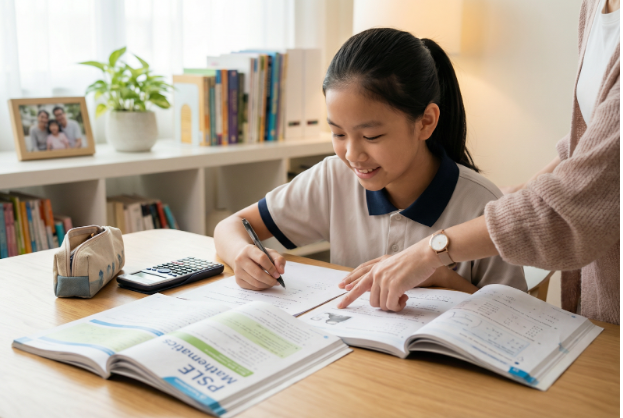
The PSLE Maths examination represents a turning point in your child’s Primary School years. Many parents ask us: what’s the best way to help our children prepare? How do we know if they’re truly ready?
Here’s what we’ve learned after years of working with P6 students. Success doesn’t come from drilling endless practice papers or cramming formulas the night before. Your child needs solid understanding, sharp problem-solving abilities, and real confidence walking into that exam hall. This guide breaks down what actually works when preparing for PSLE Maths.
Getting to Know the PSLE Maths Format
PSLE Maths has two distinct papers, each testing your child differently. Paper 1 covers the basics, like multiple-choice questions and short answers that don’t need lengthy explanations. Paper 2 goes deeper, asking students to show their working and tackle problems with multiple steps.
Your child gets one hour for Paper 1, and calculators aren’t allowed. Paper 2 gives them 90 minutes, and they can use calculators here. Knowing these differences helps you tailor revision sessions to match what each paper actually demands.
Find Out Where Your Child Really Stands
Before you map out a revision plan, you need to know the starting point. Sit down with some past-year papers and watch how your child approaches them. Better yet, have a chat with their school teacher about which topics are giving them trouble.
There’s no point spending hours on topics your child already understands perfectly. That time would be better spent on tricky areas like Ratio or those confusing Geometry word problems. Work smarter, not harder.
Understanding Beats Memorisation Every Time
We’ve seen too many students memorise solution steps without grasping why those steps work. Then exam day arrives, the question looks slightly different, and panic sets in. That’s not the foundation you want for your child.
Ask your child to walk you through their thinking when solving problems. Can they explain why they picked that particular method? If yes, brilliant… they’ve got it. If they’re just reciting steps they’ve memorised, that’s your signal to dig deeper into the concept.
Quality Practice Trumps Quantity
Yes, practice matters. But throwing 50 similar questions at your child won’t help as much as 10 varied ones that stretch their thinking in different directions.
Mix up your practice sessions. Some should be timed to build exam pace. Others should be relaxed, giving your child space to wrestle with complex problems without watching the clock. Both types of practice serve different purposes, and your child needs both.
Don’t Underestimate Paper 1
Paper 1 makes up nearly half the total marks, and it tests the fundamentals. No calculator means your child needs quick mental maths and solid grasp of basic operations.
The questions here are generally more straightforward than Paper 2. That’s precisely why scoring well on Paper 1 matters so much. These are marks your child shouldn’t be leaving on the table. Regular mental arithmetic practice and times table drills might seem old-fashioned, but they pay off here.
Paper 2 Needs Different Skills
Paper 2 questions often weave together multiple concepts in one problem. Your child needs to spot which concepts apply, figure out how they connect, and present their solution logically.
Even when your child knows the answer immediately, encourage them to write out clear working. Examiners award marks for methodology, not just final answers. Messy or unclear working loses marks even when the final answer is correct.
Tackle the Topics That Trip Students Up
Some PSLE topics consistently cause headaches. Ratio and proportion confuse students who can’t visualise how quantities relate to each other. Speed, distance, and time problems trip up kids who rush and mix up their units.
Volume and area calculations, especially in word problem form, demand spatial thinking that doesn’t come naturally to everyone. When your child hits a wall with these topics, getting help from experienced tutors through P6 Maths tuition for PSLE often makes the difference between confusion and clarity.
Confidence Matters as Much as Knowledge
Exam anxiety derails performance, sometimes dramatically. You can help by keeping the bigger picture in perspective and celebrating progress, not just perfection.
Gradually introduce exam conditions during practice. Don’t throw your child straight into full timed papers if they’re not ready. Build up their stamina and comfort with the format. When reviewing mistakes, keep the tone constructive. Every error is information about what needs more attention, nothing more.
When to Consider Getting Extra Help
Plenty of families find that professional tuition fills gaps that school lessons can’t address. Smaller class sizes mean tutors can spot exactly where understanding breaks down and target those specific areas.
Good tutors bring experience with hundreds of students and know the common pitfalls. They’ve seen every type of PSLE question and can teach specific strategies for different question formats. That expertise combined with structured revision coverage often accelerates progress noticeably.
Wrapping Up
Getting ready for PSLE Maths takes time, strategy, and consistent work. Focus on building real understanding rather than surface-level familiarity. Practice with intention, not just volume. Get support when you need it.
Most importantly, remember your child is an individual. What works brilliantly for their classmate might not click for them. Find what suits their learning style, and keep their long-term relationship with maths healthy. The PSLE is important, but it’s one milestone in a much longer journey.